Case study · Robotics · Enterprise tooling
A factory line for drones, in the browser.
Brane's Design Factory turns a vehicle request into a buildable spec: requesters describe the mission, engineers assemble compatible parts, and admins keep the teams moving. One system, three very different users.
01 · Context & business problem
Requirements lived in meetings. Builds lived in spreadsheets.
Configuring an unmanned vehicle, from drones to boats to quadrupeds, meant emails, tribal knowledge, and part lists that went stale before the first prototype.
- Requesters spoke missions, engineers spoke motors. Nothing translated between them.
- Compatibility was memory. Whether an ESC matched a motor lived in someone's head.
- Weight budgets broke late. All-up-weight problems surfaced at assembly, the most expensive possible moment.
02 · My role & constraints
UX for three users who never meet.
I designed the end-to-end flows for all three roles: requester, propulsion engineer, and admin, plus the modular design system underneath.
- The requester knows the mission, not the hardware. The interface had to accept mission language and translate it.
- The engineer needs constraints enforced, not suggested. A polite warning is not enough when physics is the reviewer.
- The admin needs teams, permissions, and progress at a glance, without ever touching a spec.
- The catalog kept growing. Drones first, but the same system had to hold boats, quadrupeds, and submarines without a redesign.
- Engineering data was the truth source. Every compatibility verdict on screen had to trace back to a real parts database, so the UI could never promise what the workshop could not build.
03 · Discovery
I followed one request from email to airframe.
Before designing anything, I traced how a single vehicle request actually moved through the factory. It was sobering.
- The request arrived as prose. A paragraph of mission intent that an engineer had to decode into components.
- The parts list lived in a spreadsheet that forked every time someone saved a copy. Nobody could say which version was current.
- Compatibility checks happened in heads. Whether an ESC matched a motor depended on who was in the room that day.
- Weight failures surfaced at assembly, after parts were ordered. The most expensive place to discover a 200 gram problem.
The design brief wrote itself: move every one of those failure points from the workshop into the interface, where fixing them costs a click instead of a part.
04 · Architecture & flows
From mission to machine, one ladder at a time.
The core idea: turn "build me a drone" into a sequence of small, checkable decisions, and never let an incompatible one through.
Requester questionnaire
- Bundle mission type
- Payload what it carries
- Software abilities needed
- Environment where it flies
- Finish spec confirmed
Engineer build ladder
- Drone
- Motor
- ESC
- Propeller
- Battery
- Frame
- A.U.W weight verdict
05 · Key decisions & tradeoffs
Constraints as a feature, not a fence.
Three calls shaped the product. Each one had a real alternative that lost for a reason.
- Verdicts on part cards, not error modals. The alternative was validating the build at the end. Rejected: late errors are exactly the spreadsheet problem we were replacing.
- Incompatible parts go quiet, not red. We considered showing everything with error states. Filtering incompatible parts out of view keeps the engineer choosing among winners instead of dodging losers. The tradeoff: an engineer might wonder where a part went, so a filter note says how many were hidden and why.
- The weight budget travels with the ladder. A summary page at the end would have been simpler to build. Instead the A.U.W table follows every step, because a budget you see only at checkout is a bill, not a budget.
- Requesters never see part numbers. The questionnaire mirrors their choices back in mission language on the Confirm Specifications rail. The tradeoff is a translation layer we had to maintain, and it was worth it: requesters stopped needing an engineer to fill in a form.
06 · What shipped & what it proves
One system, three experts, zero translation meetings.
Design Factory shipped as Brane's internal requirements-to-build tool. Outcomes stayed inside the factory walls, so I will not dress them in numbers. What the work itself demonstrates:
- I can design for expertise I do not have. Propulsion engineers accepted verdicts from a screen because the system respected how they actually judge parts.
- I can make one design system serve opposite temperaments: a guided, friendly questionnaire and a dense, uncompromising build ladder, without either feeling borrowed.
- I design for the failure case first. The A.U.W banner exists because the most expensive moment in the old process was the one nobody had designed.
07 · What I would do differently
Prototype the weight math first.
The A.U.W reconciliation table became the heart of the product, but it arrived in the second design pass, after engineers kept sketching weight budgets on paper next to the screen. The artifact users improvise is the feature they needed first; I now look for it in week one.
01 · The essence
Precision, wearing a friendly face.
Aerospace tooling usually looks like a spreadsheet with a grudge. This one is soft-shouldered SaaS: violet structure on lavender air, parts as cards you could almost pick up. Underneath, the compatibility engine is as strict as the physics it protects.
02 · Foundations
Violet with verdicts.
The palette
Values sampled from the shipped screens. Two verdict colors carry every build decision.
#6C4FE0 nav · actions #4B36A6 sidebar #F3F1FB #FFFFFF #F2A93B ribbons #3DBE7B pills #2A2740 #8B87A3 The type scale
Engineering data wants a workhorse sans. Weights separate specs from prose, never color.
The spacing rhythm
4 8 16 24 32 The corners
Cards · 12 Buttons · 8 Pills · 999 The product's own components
03 · Key screens
The three rooms of the factory.
The questionnaire: missions in, specs out
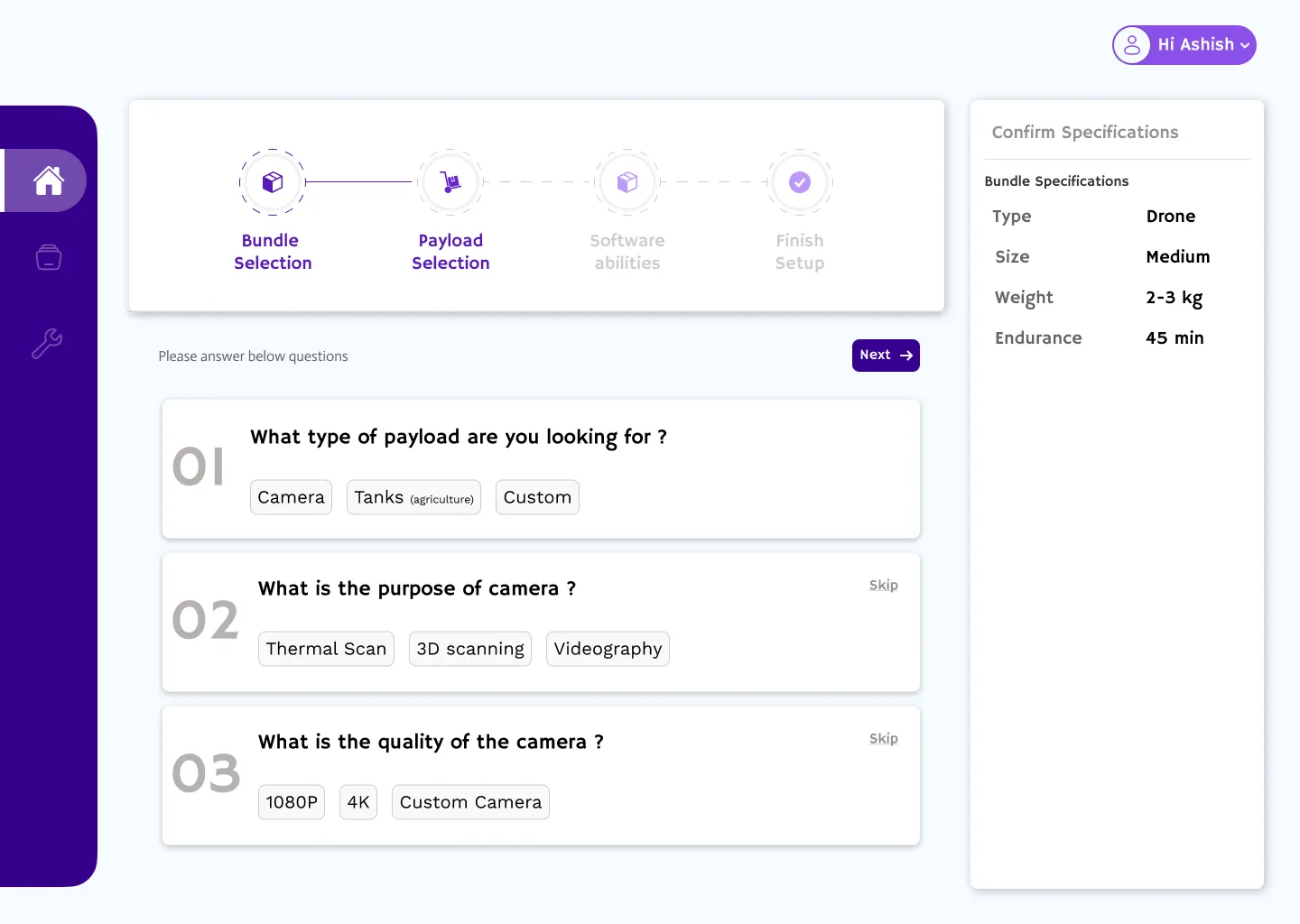
Big tappable choices, one question per screen, and a persistent rail that turns answers into a confirmable specification.
The build ladder: parts with verdicts
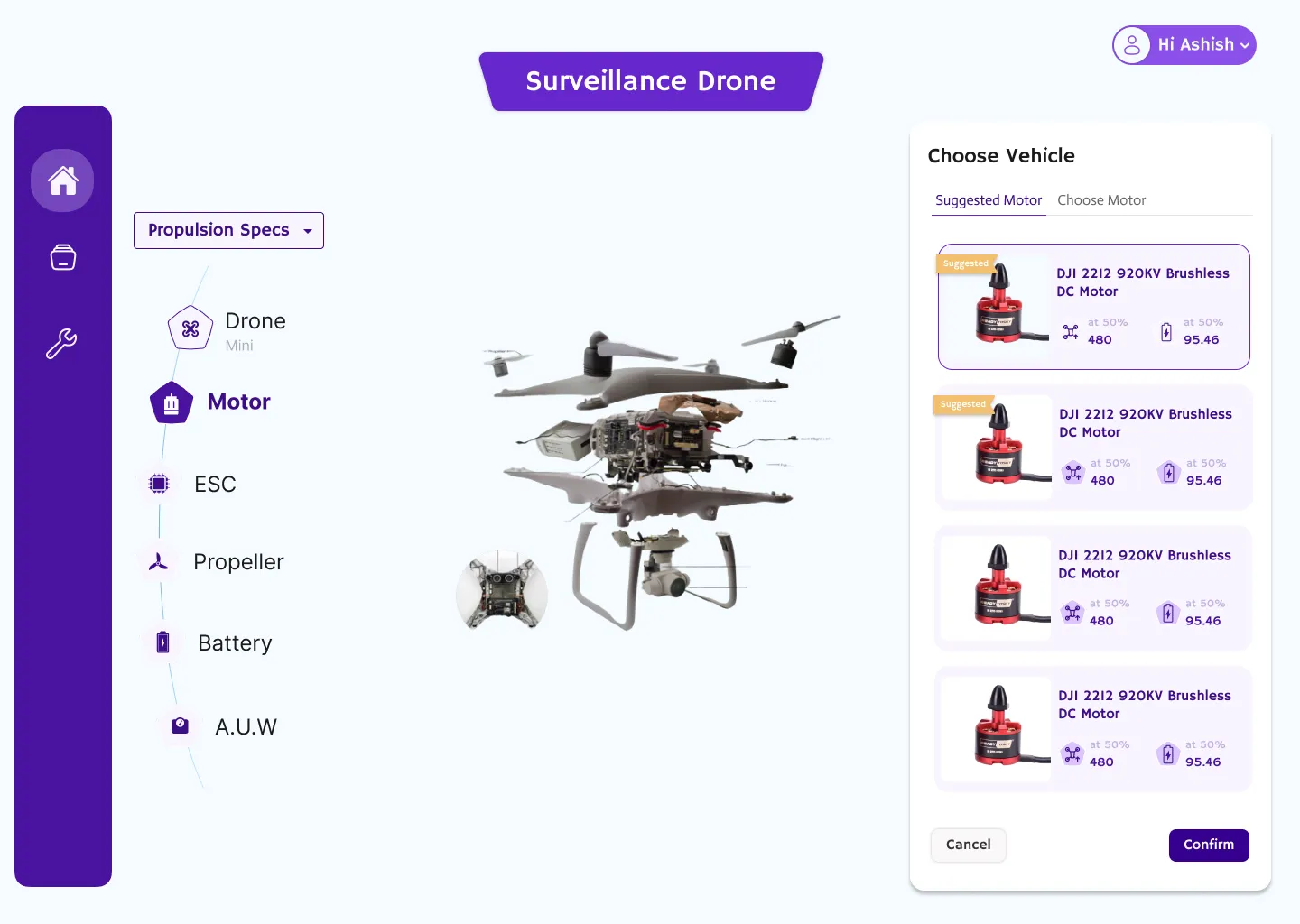
The engineer descends Drone → Motor → ESC → Propeller → Battery → Frame, and every candidate part already knows whether it fits.
The weight verdict: physics, reconciled
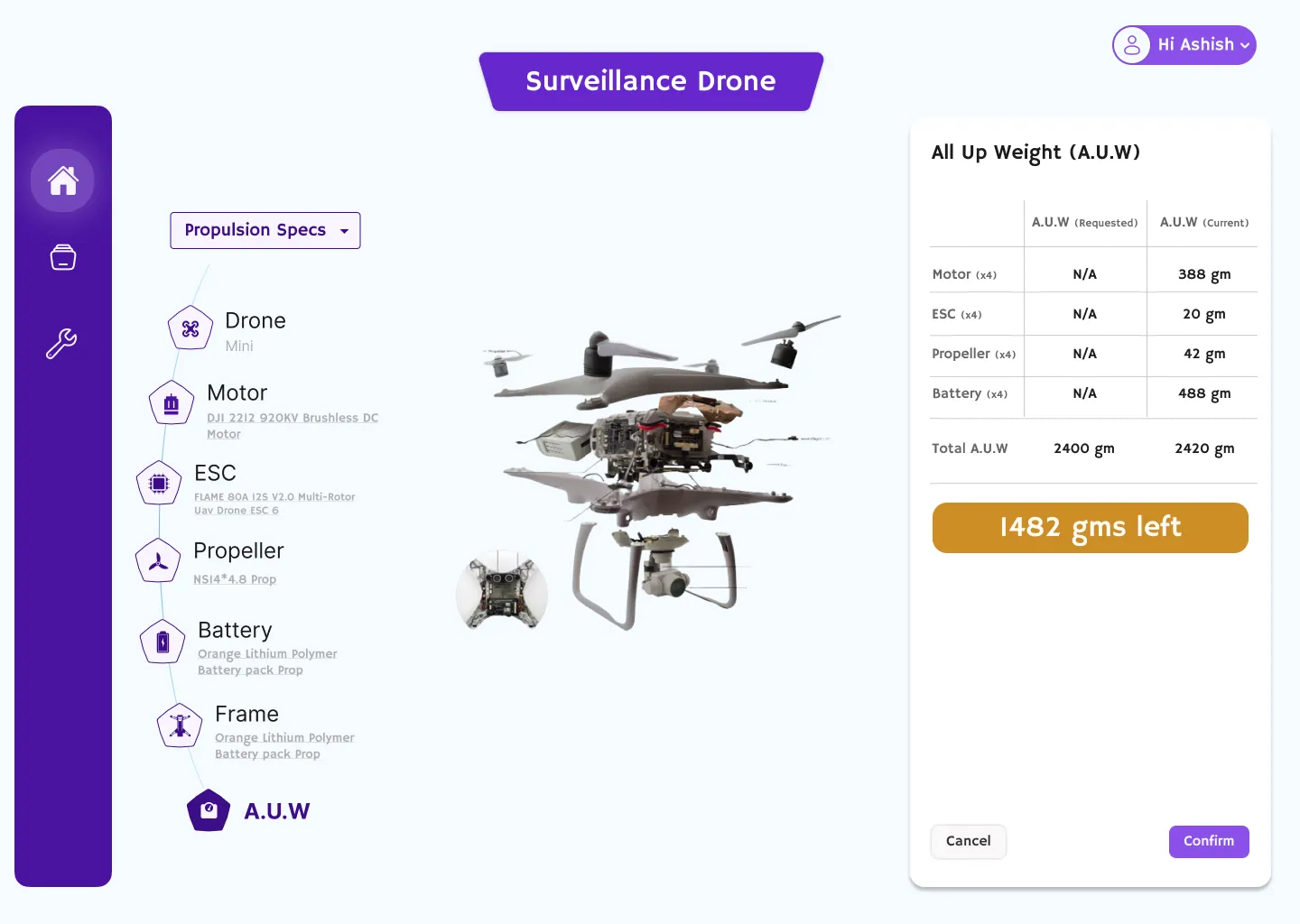
The A.U.W table is the product's conscience, the one screen where the build either adds up or goes back a rung.
04 · Motion & micro-interactions
Feedback at the speed of a decision.
- The Suggested ribbon slides in when the system finds a recommended part, so recommendations feel discovered, not preloaded.
- The A.U.W banner recounts the remaining grams the moment a part is added, a small ticker that makes the physics feel live.
- Completed ladder rungs get a settle animation, a quiet confirmation that a decision is locked before the next one opens.
- Disabled Add buttons explain themselves on hover, naming the constraint instead of just refusing.
05 · A note on numbers
Internal tool, honest scope.
Design Factory shipped as internal tooling at Brane, so the screens above carry sample data and its outcomes stayed inside the factory walls. What it proves publicly: I can make three very different experts share one system without any of them compromising.